1D Interpolation for B/H, D/H, rb/H
A precursor to this example may be the Dimensioning Rules Example.
Computing Library-like g-Functions
A 7x10 borehole field is created using https://github.com/j-c-cook/Rectangle-Bore-Field-Generator. That layout can be seen in Fig. 3.
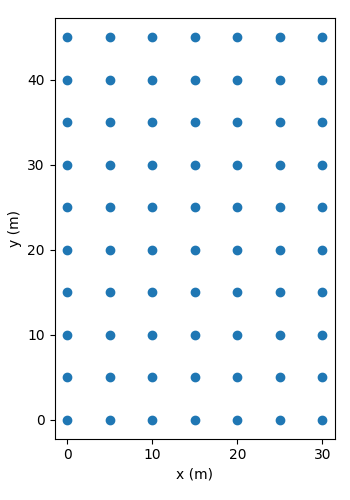
Fig. 3 7x10 borefield layout with 5m uniform spacing
A library like range of g-functions are computed using the following inputs.
It should be noted that this corresponds to an rb/H = 0.0005 and D/H = 0.02083.
The g-functions are visualized in Fig. 4

Interpolation for g, D, rb
The table above gives the input values. It can be seen that there are varying D and rb values to keep the D/H ratio and rb/H ratio constant. Therefore, interpolating for a g-function using a B/H ratio will also result in a new rb and D value, though in this case the rb/H and D/H ratios should remain the same even after interpolation.
A B and H value of 8m and 128m are respectively selected for this interpolation example. This corresponds to a B/H of 0.0625, therefore the interpolated value should fall in between the green and red curves in Fig. 4. That corresponds to rb values in a range of 0.024m-0.048m and D values to fall within 1m-2m. The resulting output is the following:
rb = 0.0400     rb/H_eq = 0.0005
D = 1.66667     D/H_eq = 0.02083
The interpolated rb/H and D/H ratios make sense. However, notice that the height is referred to as H_eq or
an equivalent height. This is what is returned from calling the interpolation function,
gFunctionLibrary.handle_contents.Borefield.g_function_interpolation(). This occurs because the interpolation for
a new g-function is a function that is dependent on height.
Where f could be any method of interpolation: linear, quadratic, cubic, lagrange, etc. This function is originally fit with as many points as there are curves in the library for a particular configuration.
The interpolated g-functions accuracy has already been proven in Dimensioning Rules Example. The interpolated g-function is added and the plot presented in Fig. 5

Fig. 5 The g-functions for the 7x10 borefield and an interpolated g-function for a B/H=0.0625
Source Code
 1# Jack C. Cook
 2# Wednesday, February 3, 2021
 3
 4"""
 5**interpolation_1D.py**
 6
 7This example focuses on 1D interpolation over B/H ratios
 8"""
 9
10import gFunctionDatabase as gfl
11import matplotlib.pyplot as plt
12
13
14def main():
15    path_to_file: str = 'files/lib/7x10_B_5_nbh_70.json'  # give a path to a file containing computed g-functions
16    data: dict = gfl.fileio.js_r(path_to_file)  # if we were to lookup in the library we would have this dict
17    # pass the data into the borefield class
18    bf = gfl.handle_contents.Borefield(data)
19    # visualize this borefield
20    fig_1, ax_1 = bf.visualize_borefield()
21    fig_1.savefig('7x10_borefield.png')
22    plt.close(fig_1)
23    # visualize the g-functions
24    fig_2, ax_2 = bf.visualize_g_functions()
25    fig_2.savefig('7x10_g_functions.png')
26    # dont close the figure yet so we can add on the interpolation curve
27
28    # interpolate for a B/H value
29    B: float = 8.
30    H: float = 128.
31    # the default for the kind of interpolation is
32    g_interpolated, rb_interpolated, D_interpolated, H_eq = bf.g_function_interpolation(B/H)
33
34    print('The interpolated g-function for a B/H = {}/{}:'.format(B, H))
35    print(g_interpolated)
36    print('rb = {0:.4f}\trb/H_eq = {1:.4f}'.format(rb_interpolated, rb_interpolated / H_eq))
37    print('D = {0:.5f}\tD/H_eq = {1:.5f}'.format(D_interpolated, D_interpolated / H_eq))
38
39    ax_2.plot(bf.log_time, g_interpolated, '^')
40    fig_2.savefig('7x10_g_functions_w_interpolated.png')
41    plt.close(fig_2)
42
43    # Consider that the borehole radius of the design is different from the interpolated one
44    rb_design = 0.075  # borehole radius (m)
45    g_function_corrected = gfl.handle_contents.borehole_radius_correction(g_interpolated,
46                                                                          rb_interpolated,
47                                                                          rb_design)
48
49
50if __name__ == '__main__':
51    main()